
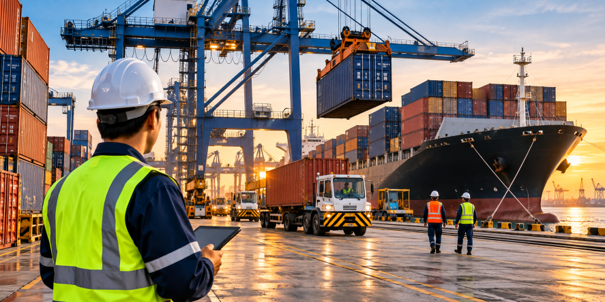
Ports and terminals are among the most dynamic workplaces in the logistics industry. Containers arrive and leave continuously, cranes move heavy loads above working areas, trucks and terminal equipment operate within confined traffic zones, ships are loaded and discharged under strict schedules, and hazardous cargo may be handled only metres away from other activities. In major Asian ports, these operations take place on an enormous scale and often continue around the clock.
From Singapore and Hong Kong to Busan, Shanghai, Port Klang, Tanjung Pelepas, Laem Chabang, Manila, Jakarta, Mumbai and many other maritime centres, safe port operations depend on much more than modern equipment. Employees must understand the hazards associated with their work and know how to perform their tasks safely.
Safety training for ports and terminals is therefore an essential part of an effective occupational safety system. Where dangerous goods are involved, training also becomes an important element of regulatory compliance under the International Maritime Dangerous Goods (IMDG) Code.
Why port and terminal work requires specific safety knowledge
A container terminal brings together people, machines, vehicles, ships and cargo in a constantly changing environment. Unlike a conventional warehouse, the workplace itself is continuously moving. A container that was not present an hour ago may suddenly become part of the operational area, while trucks, reach stackers, straddle carriers and other equipment move cargo between different locations.
This creates a combination of hazards.
Workers can be exposed to moving vehicles, suspended loads, falls from height, confined spaces, hazardous substances, fires, leaking cargo and unstable containers. Weather conditions can introduce additional risks. Heavy rainfall, tropical heat, strong winds and lightning can affect operations at many Asian ports.
The International Labour Organization’s Code of Practice on Safety and Health in Ports addresses the broad range of activities associated with port operations, including cargo handling, access, lifting equipment, transport operations, dangerous goods and personal protective equipment.
Training should therefore reflect the actual activities employees perform rather than simply providing generic safety information.
Container handling and moving equipment
One of the most visible hazards within a container terminal is the interaction between people and heavy mobile equipment.
Terminal tractors, reach stackers, forklifts, cranes and straddle carriers may have significant blind spots. Even when operators are well trained, pedestrians entering operational areas without understanding traffic rules can create dangerous situations.
Effective port safety training should make employees familiar with designated pedestrian routes, exclusion zones, communication procedures and site traffic rules. Workers should understand that making eye contact with an equipment operator does not necessarily mean that the operator has seen them or can safely stop the vehicle.
The same principle applies to lifting operations. Nobody should position themselves underneath a suspended container or other load. Employees need to understand exclusion zones and why they must never take shortcuts through active lifting areas.
These may appear to be basic safety principles, but in a high-pressure operational environment, routine can gradually reduce risk awareness. Regular training and reinforcement help prevent unsafe behaviour from becoming normal practice.
Dangerous goods in ports and terminals
Dangerous goods introduce another dimension to port safety. Containers may contain flammable liquids, corrosive substances, toxic materials, gases, oxidising substances, lithium batteries or other regulated cargo.
The International Maritime Dangerous Goods Code provides the international framework for the safe transport of dangerous goods by sea. The Code addresses subjects such as classification, packaging, marking, labelling, placarding, documentation, segregation, stowage and transport operations.
For terminal personnel, recognising dangerous goods is particularly important.
A container carrying dangerous goods should normally display the applicable placards and other markings. These communicate important information about the hazards associated with the cargo. Employees who work around containers do not necessarily need to become dangerous goods specialists, but they should understand the basic hazard classes and know what these labels and placards mean.
A Class 3 placard, for example, indicates a flammable liquid hazard. Class 8 identifies corrosive substances, while Class 2 covers gases. Class 9 includes miscellaneous dangerous substances and articles and is also relevant to many lithium battery shipments.
Recognising these hazards can influence decisions made during normal operations as well as during emergencies.
IMDG training requirements for shore-based personnel
Training becomes especially important when employees actually perform functions related to the transport of dangerous goods.
Chapter 1.3 of the IMDG Code establishes training requirements for shore-based personnel engaged in the transport of dangerous goods intended to be transported by sea. Training must be appropriate to the employee’s responsibilities.
This can apply to personnel who classify dangerous goods, pack them, mark or label packages, prepare transport documentation, load or unload cargo transport units, accept dangerous goods for transport, prepare loading or stowage plans or otherwise handle dangerous goods in the transport chain.
Training therefore cannot always be solved by giving every employee exactly the same course.
A documentation employee requires different detailed knowledge from somebody responsible for packing a container. A cargo handler needs to understand the requirements applicable to their function, while an employee who prepares dangerous goods documentation needs sufficient knowledge to perform that particular task correctly.
This concept is commonly described as function-specific training.
Loading and unloading cargo transport units
Container loading deserves particular attention because mistakes made during packing can remain hidden until something goes wrong.
Packages must be suitable for the goods they contain and must be properly secured. Incompatible dangerous goods may require segregation. Packages should be inspected for damage before loading, and the weight of cargo must be appropriately distributed.
Cargo securing is also important. A container experiences movement during road transport, terminal handling and the sea voyage itself. Poorly secured drums, intermediate bulk containers or packages can move, become damaged or leak.
Personnel responsible for packing and handling dangerous goods therefore need more than general awareness. They need knowledge that corresponds with the work they actually perform.
For employees involved in these activities, the IMDG Code Packer Course (English) available through Yoursafetystore.asia provides dedicated training for packers and cargo handlers involved in packing dangerous goods and loading or unloading cargo transport units.
Segregation can prevent a small incident becoming a major emergency
One of the fundamental principles of dangerous goods transport is that certain substances must be kept apart.
The reason is straightforward. If incompatible substances are stored or transported together and their packages become damaged, the substances may react with each other. The resulting reaction can generate heat, fire, toxic gases or other dangerous conditions.
The IMDG Code therefore contains segregation requirements governing combinations of dangerous goods.
Port and terminal employees involved in dangerous goods operations should understand the importance of these requirements. They should never assume that two containers can safely be positioned together merely because both are properly packaged.
Operational planning, temporary storage and container movements must take dangerous goods requirements into account.
What happens when a container starts leaking?
Training becomes particularly valuable when normal operations suddenly turn into an emergency.
Imagine that a terminal worker notices liquid dripping from a container. The first reaction should not automatically be to approach the container and investigate the leak at close range.
The contents may be flammable, toxic, corrosive or otherwise hazardous.
Employees should understand the site’s emergency procedures and know how to raise the alarm, establish a safe distance and communicate relevant information. Dangerous goods markings, container numbers and transport information can help trained emergency personnel determine an appropriate response.
Trying to solve an unfamiliar hazardous-material incident without suitable training and protective equipment can make the situation significantly worse.
Emergency response training should therefore be integrated into the wider safety programme of the terminal.
Fire safety and lithium batteries
Lithium batteries have become an increasingly important cargo category within international logistics. They are transported as individual batteries, packed with equipment, contained in equipment and increasingly as part of large energy-storage systems.
Damaged or defective lithium-ion batteries can present significant fire hazards. Thermal runaway may generate intense heat and can involve flammable and toxic decomposition products.
Port personnel should therefore understand that a container involving lithium batteries can require different emergency considerations from ordinary cargo.
The same applies to other dangerous goods. A fire involving flammable liquids, oxidisers or certain reactive substances may require specialised response strategies. Employees do not all need to become emergency-response specialists, but they should understand the importance of identifying the cargo and immediately communicating relevant dangerous goods information to emergency responders.
Safety training must match the employee’s function
One of the most effective approaches to port safety is to divide training into levels.
General employees need basic workplace safety knowledge covering traffic, PPE, emergency alarms, restricted areas and common hazards. Personnel involved with dangerous goods additionally need appropriate dangerous goods awareness. Employees performing specific IMDG functions require training corresponding with those responsibilities.
Supervisors need another layer of competence. They should understand not only operational procedures but also why those procedures exist and when work needs to be stopped because conditions have become unsafe.
This approach creates a safety system rather than a collection of certificates.
Training should also be periodically refreshed. Regulations change, terminal equipment changes and new cargo risks emerge. Knowledge acquired several years ago cannot automatically be assumed to remain sufficient indefinitely.
Online IMDG training for Asian port operations
Asian logistics companies often operate across multiple countries, languages and locations. E-learning can therefore provide a practical way to establish a consistent level of dangerous goods knowledge across an organisation.
Yoursafetystore.asia provides IMDG training for different functions within the maritime transport chain. The webshop includes courses for awareness, packers and cargo handlers, as well as consignors and freight forwarders.
For personnel directly involved in packing dangerous goods or loading and unloading cargo transport units, the E-learning IMDG Code Packer Course (English) is particularly relevant. The course covers the international regulatory framework, dangerous goods classes, packing groups, safety and segregation requirements.
Online training also allows employees to complete theoretical training without requiring entire operational teams to leave the terminal simultaneously.
Creating a stronger safety culture in Asian ports
Training alone cannot make a port safe. Safe equipment, suitable procedures, maintenance, supervision, traffic management, emergency planning and management commitment are equally important.
Training connects these elements.
A trained employee is more likely to recognise a damaged dangerous goods package, understand the meaning of a placard, respect an exclusion zone or report an unsafe condition before it develops into an incident.
This is especially important in ports, where a seemingly small mistake can affect workers, ships, cargo, surrounding businesses and potentially communities outside the terminal.
As Asian ports continue to handle increasing volumes of sophisticated and hazardous cargo, investment in employee competence should develop alongside investment in cranes, automation and terminal capacity.
Modern ports need modern safety systems. Effective, function-specific safety training is one of their foundations.
