
Asia is one of the world’s most important chemical manufacturing and logistics regions. Major petrochemical complexes, refineries, pharmaceutical factories, industrial parks, tank terminals and chemical warehouses can be found from Singapore and Malaysia to China, India, South Korea, Japan, Thailand, Indonesia and the Middle East. Every day, enormous quantities of raw materials, intermediates and finished chemical products are produced, stored and transported through these industrial networks.
Working in the chemical industry inevitably introduces hazards. Employees may encounter flammable liquids, toxic substances, corrosive chemicals, gases under pressure, oxidising materials or substances capable of reacting dangerously when mixed. At larger process installations, an uncontrolled release can potentially escalate into a fire, explosion or toxic cloud affecting not only employees but also neighbouring facilities and communities.
Safety Training for Chemical Companies in Asia should therefore be regarded as part of an integrated chemical-safety management system. Training helps employees understand the substances, processes and activities around them and, most importantly, recognise when normal operating conditions are beginning to become unsafe.
Chemical safety starts with understanding the hazard
An employee cannot effectively control a chemical hazard without first understanding what that hazard is.
This sounds obvious, yet chemical workplaces frequently contain hundreds or even thousands of products. Some present immediate hazards such as fire, explosion or acute toxicity, while others can cause health effects after repeated or long-term exposure.
The Globally Harmonized System of Classification and Labelling of Chemicals, commonly known as GHS, provides an internationally structured approach for classifying chemical hazards and communicating them through labels and Safety Data Sheets.
Employees should be able to recognise the basic hazard pictograms and understand the difference between physical, health and environmental hazards. They should also know where additional information can be found.
This is where the Safety Data Sheet becomes essential.
An SDS contains information about identification, hazards, composition, first aid, firefighting, accidental release, handling, storage, exposure controls, physical properties and other relevant subjects. Employees do not necessarily need to memorise every section, but they should know how to use an SDS when they need information.
GHS does not mean that every Asian country has identical rules
International companies need to recognise an important distinction.
GHS provides a globally harmonised framework, but implementation occurs through national or regional legislation. Companies should therefore not assume that chemical-safety requirements are identical throughout Asia simply because several countries use GHS-based systems.
Singapore, Malaysia, Thailand, Indonesia, India, China, Japan, South Korea and other jurisdictions maintain their own occupational safety and chemical regulatory frameworks.
A multinational chemical company can establish strong corporate standards, but these must still be checked against the legal requirements applicable to each facility.
Training programmes should reflect the same principle. Corporate e-learning can provide a common safety baseline, while site-specific and legally required training must be added locally.
Chemical storage requires compatibility thinking
Chemical storage involves more than placing drums, IBCs or containers inside a designated chemical warehouse.
Different substances can react dangerously when they come into contact.
Oxidising substances may intensify combustion. Acids and alkalis can react strongly. Certain chemicals can release toxic gases when mixed, while flammable liquids require careful control of ignition sources.
Employees responsible for storage should therefore understand chemical compatibility and segregation principles.
This becomes especially important when an incident occurs. Imagine a forklift punctures an IBC containing a corrosive substance. If the escaping product reaches another incompatible chemical stored nearby, the initial leak can escalate into a much more serious event.
Chemical storage should consequently be designed around credible scenarios rather than only around efficient use of floor space.
Process safety goes beyond occupational accidents
Traditional occupational safety often focuses on incidents involving individual employees: falls, cuts, manual handling injuries or contact with chemicals.
Chemical companies also need to consider process safety.
Process safety is concerned with preventing uncontrolled releases of hazardous substances and energy from industrial processes. A failure can potentially result in a major fire, explosion or toxic release.
The causes are rarely limited to one employee making one mistake.
Corrosion, overpressure, incorrect valve positions, instrument failures, loss of cooling, maintenance errors, incompatible chemicals and failures of safety systems can all contribute to an incident.
Employees working in process environments therefore need to understand the operating boundaries of the installation and the importance of reporting abnormal conditions.
A leaking flange, unexplained pressure increase or unusual temperature reading should not become normal simply because the installation continues operating.
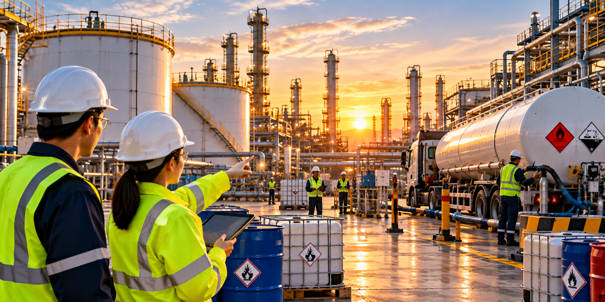
Loading and unloading are critical chemical operations
Chemical transfer is one of the activities where process, transport and occupational safety come together.
When a tank truck arrives at a chemical facility, several things must be correct before transfer begins. The vehicle must be connected to the correct installation, the receiving tank must contain the correct product or be compatible with it, sufficient capacity must be available and hoses and connections must be suitable for the substance being transferred.
One incorrect connection can potentially introduce the wrong chemical into a tank.
Personnel involved with these activities therefore need to understand the product, equipment and procedure as well as the actions required if something goes wrong.
Yoursafetystore.asia offers the E-learning Loading and Unloading of Chemical Tank Trucks (English) course for operators, drivers and personnel involved with these activities. It covers transfer procedures, PPE, potential incidents and the responsibilities associated with chemical loading and unloading.
The course is particularly useful as awareness or periodic refresher training alongside the practical, site-specific competence required for actual transfer operations.
Dangerous goods knowledge connects production with logistics
A chemical company does not stop being responsible for safety when a product leaves the production line.
Chemicals may subsequently be filled into drums, IBCs or tanks and transported by road, sea or air. Employees involved with preparing these shipments may therefore encounter dangerous goods legislation in addition to workplace chemical legislation.
This introduces another important distinction.
GHS hazard communication and dangerous goods transport classification are related, but they are not identical systems. A workplace chemical label cannot simply be assumed to satisfy all transport requirements.
Personnel involved in packaging, marking, labelling, documentation or transport need training appropriate to the functions they perform and the transport modes involved.
For employees requiring a general introduction, the E-learning Course Awareness Dangerous Goods (English) from Yoursafetystore.asia covers dangerous goods legislation, classification, Safety Data Sheets and spill management.
More specialised functions may require additional ADR, IMDG, IATA or national dangerous goods training.
Explosion safety is essential where flammable substances are present
Chemical facilities frequently handle flammable gases, vapours and liquids capable of creating explosive atmospheres.
Where this is possible, ignition sources need to be systematically controlled.
Employees should understand that ignition sources extend beyond smoking and open flames. Electrical equipment, hot surfaces, mechanical sparks and electrostatic discharges can also provide sufficient energy to ignite an explosive atmosphere.
Hazardous areas may therefore be classified into zones, with appropriate explosion-protected equipment selected for the location.
Awareness training is useful for employees entering these areas, while installation, inspection, maintenance and repair of explosion-protected equipment require appropriately competent personnel.
For organisations working with potentially explosive atmospheres, an IECEx Awareness Training course can therefore form another useful component of the wider chemical-industry training matrix.
Maintenance requires control of hazardous energy
Chemical installations can contain significant stored energy even after equipment has apparently been shut down.
Pressure may remain inside piping. A vessel may contain hazardous residues. Electrical equipment can remain energised, while hydraulic or pneumatic systems may retain pressure.
Maintenance personnel therefore need effective isolation procedures.
Lockout/tagout principles can help prevent equipment from being unexpectedly energised, but chemical installations often require additional process isolation. Depending on the activity, this may include closing and securing valves, draining, depressurising, purging or physically separating process equipment.
The employee carrying out maintenance should never have to guess whether an installation is safe to work on.
Training should reinforce the principle that isolation must be established and verified before hazardous work begins.
Emergency response must be based on credible scenarios
Emergency planning at a chemical company should reflect the substances and installations actually present.
Generic instructions such as “evacuate in case of emergency” are not enough.
A flammable-liquid spill, toxic gas release, chemical reaction, tank overfill and warehouse fire can require very different responses.
Employees need to understand alarms, evacuation arrangements and reporting procedures. Personnel expected to intervene require additional training, suitable PPE and appropriate equipment.
Scenario-based exercises are particularly valuable.
A team can practise what happens when a tanker hose starts leaking, an IBC is damaged by a forklift or a detector indicates a gas release. These exercises do not always need to become full-scale emergency drills. Short practical scenarios can reveal whether employees actually understand procedures.
The objective is to discover weaknesses during an exercise rather than during an accident.
Contractors must be part of the safety system
Chemical companies frequently use contractors for maintenance, construction, cleaning, inspection and specialist technical work.
These workers can be unfamiliar with the installation while performing some of the highest-risk activities on site.
Contractor safety therefore requires more than issuing a visitor badge.
Contractors need information about relevant hazards, emergency arrangements, restricted areas and permit-to-work procedures. Their competence for specialist activities should also be verified.
Site personnel need to understand the contractor’s work as well. Two individually safe activities can create a dangerous combination when performed simultaneously.
This makes communication and coordination an essential part of chemical-industry safety.
Training should be based on function and risk
Not everybody in a chemical company requires the same level of training.
A production operator needs detailed knowledge of the process and substances used in that area. A warehouse employee requires knowledge relating to storage, segregation and material handling. Maintenance technicians need isolation and permit-to-work competence. Logistics employees may require dangerous goods training, while emergency responders need specialist response skills.
Managers and supervisors need sufficient understanding to recognise when work is being performed outside acceptable conditions.
A strong training matrix therefore connects function, hazard and competence.
Online training can provide theoretical knowledge efficiently across multiple locations, but it should be combined with workplace instruction, practical exercises and competence assessment where necessary.
Building chemical safety competence across Asia
The chemical industry will remain fundamental to Asia’s industrial development. Energy transition, battery production, semiconductors, pharmaceuticals, advanced materials and hydrogen technologies will introduce new processes while traditional petrochemical and manufacturing activities continue.
This makes chemical-safety competence increasingly important.
Training alone cannot prevent every accident. Safe design, maintenance, engineering controls, management systems, inspections and effective emergency planning remain essential.
Training connects people to those systems.
An employee who understands chemical hazards is more likely to question an incorrect connection. A trained warehouse worker is more likely to recognise incompatible storage. A maintenance technician who understands isolation is less likely to begin work on equipment containing residual pressure.
These individual decisions form part of the larger safety system.
Effective Safety Training for Chemical Companies in Asia should therefore move beyond simply issuing certificates. Its purpose is to create employees who understand hazards, recognise deviations and know when work should stop.
That competence is one of the strongest barriers a chemical company can build between normal operations and a major incident.
