
Warehousing has become one of the foundations of Asia’s rapidly expanding logistics economy. From enormous distribution centres serving e-commerce platforms to chemical warehouses, cold stores, manufacturing logistics centres and port-related facilities, millions of products move through Asian warehouses every day. Singapore, Malaysia, Thailand, Vietnam, India, China, Indonesia, South Korea, Japan and other major markets all depend on increasingly sophisticated warehouse networks.
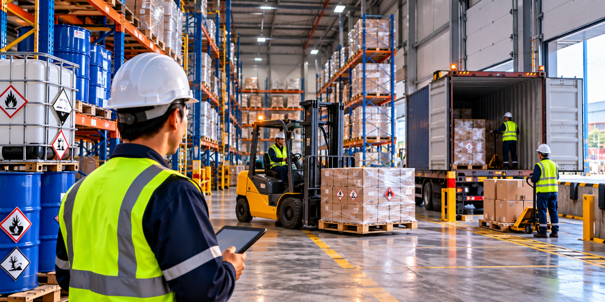
Modern warehouses may appear highly organised, but they combine numerous hazards within a relatively confined workplace. Forklifts operate alongside pedestrians, pallets are stored several metres above floor level, trucks are continuously loaded and unloaded, employees manually handle goods, automated equipment moves without conventional drivers and some facilities store chemicals or dangerous goods.
Safety Training for Asian Warehouses therefore needs to address the real risks of modern logistics. Good training does more than explain rules: it helps employees recognise when an ordinary warehouse activity is beginning to become unsafe.
Warehouse safety starts with understanding the workplace
No two warehouses are exactly the same.
A distribution centre storing consumer electronics has different risks from a chemical warehouse. A refrigerated food warehouse presents different working conditions from an e-commerce fulfilment centre, while a warehouse connected to a container terminal may regularly receive internationally regulated dangerous goods.
Training should consequently begin with the hazards employees actually encounter.
Typical warehouse risks include collisions with forklifts, falling goods, damaged storage racks, slips and trips, manual handling injuries, loading-dock incidents and fires. Where chemicals are stored, employees can additionally encounter flammable, corrosive, toxic or environmentally hazardous substances.
The growth of automation introduces another dimension. Automated guided vehicles, robotic systems and sophisticated conveyors can improve safety by reducing manual work, but they also change the way people interact with machinery.
Training needs to evolve alongside these technologies.
Forklifts and pedestrians should never be treated as an ordinary combination
One of the most important warehouse hazards is the interaction between people and mobile equipment.
Forklifts, reach trucks and pallet-moving equipment frequently operate in areas where warehouse employees are picking, checking or preparing goods. The operator’s visibility can be restricted by the vehicle itself or by the load being transported.
Pedestrians should therefore understand traffic routes, crossings, exclusion areas and site rules. Operators need appropriate training for the equipment they use, while warehouse design should separate people and vehicles wherever reasonably practicable.
Simply painting lines on the warehouse floor does not automatically create safe separation.
Traffic management requires clear routes, suitable visibility, controlled intersections and rules that employees actually understand and follow. High-visibility clothing can make pedestrians easier to see but should never become a substitute for good traffic management.
Training should reinforce a simple principle: pedestrians and heavy moving equipment should interact as little as possible.
Safe storage requires more than putting pallets on racks
Storage systems are often so familiar that their hazards become almost invisible.
A pallet weighing hundreds of kilograms positioned several metres above the floor contains significant potential energy. If a rack is damaged, overloaded or incorrectly used, the consequences can be serious.
Racking should therefore be inspected and protected from vehicle impacts. Damage caused by a forklift should be reported rather than ignored because the rack still appears to be standing.
Loads must also be stable.
Heavier loads are generally better positioned at lower levels where appropriate, while loose or unstable goods require suitable securing. Employees should understand rack load limitations and should never modify storage configurations without determining whether the system remains suitable.
Good housekeeping is equally important. A broken pallet, discarded packaging material or stretch film left in an aisle can quickly become a trip or vehicle hazard.
Warehouse safety is often determined by these seemingly small details.
Loading docks are transition zones with multiple hazards
The loading dock connects the warehouse with the external transport system, making it one of the most dynamic parts of the operation.
Trucks arrive and depart, trailers are positioned, forklifts move between warehouse and vehicle, doors open and close and employees may work close to an unprotected dock edge.
Several controls need to operate together.
Vehicles should be prevented from unexpectedly moving while loading is taking place. Dock plates or levellers need to be suitable for the expected load. Employees should understand when it is safe to enter a trailer and how communication between the driver and warehouse personnel is organised.
Trailer condition also matters. A damaged floor may not safely support a loaded forklift.
Training should therefore encourage employees to assess the situation before simply driving into a newly arrived vehicle.
Dangerous goods require additional knowledge
Many Asian warehouses handle products that fall within dangerous goods or hazardous chemical classifications.
These can include paints, solvents, aerosols, cleaning chemicals, gas cylinders, lithium batteries, pesticides and industrial chemicals. Some hazards are obvious, while others may be hidden inside equipment or packaged products.
Employees need to understand how hazardous products can be identified and where safety information can be found.
Safety Data Sheets provide essential information concerning chemical hazards, handling, storage, protective measures and emergency response. GHS labels communicate workplace chemical hazards, while transport packages can carry dangerous goods labels and marks associated with regulations such as IMDG, IATA or national road-transport requirements.
Employees should understand that workplace chemical labelling and transport dangerous goods labelling are related safety systems but are not identical.
For warehouse personnel who regularly or occasionally encounter dangerous goods, Yoursafetystore.asia provides the E-learning Course Awareness Dangerous Goods (English). The course addresses dangerous goods legislation, classification, hazard communication, Safety Data Sheets and spill management and is specifically intended for people working with dangerous goods in environments including warehouses.
Chemical compatibility matters in storage
A common mistake is to assume that all dangerous goods can simply be placed in one designated hazardous-material area.
Different chemicals can react dangerously if they come into contact.
Acids and alkalis, oxidising substances and combustible materials, or other incompatible combinations may require separation or segregation. The exact requirements depend on the substances, quantities and applicable national regulations.
This makes the Safety Data Sheet an important source of information, but warehouse operators also need a structured storage strategy.
The question should not only be, “Is this a dangerous substance?” but also, “What can happen if this product leaks and comes into contact with the products stored around it?”
That way of thinking transforms chemical storage from a shelving exercise into risk management.
Lithium batteries create a growing warehouse challenge
Asia is at the centre of global battery and electronics manufacturing, making lithium batteries increasingly relevant to warehouse safety.
Lithium-ion batteries are generally safe when correctly manufactured, handled and stored, but damaged, defective or overheating batteries can create serious fire situations. Thermal runaway can release heat and flammable decomposition products and can potentially propagate from one battery or cell to another.
Employees should therefore know how to recognise signs of abnormal battery behaviour such as swelling, unusual heat, damage, smoke or unusual odours.
Damaged batteries should not simply be returned to normal stock.
Warehouses storing substantial quantities of lithium batteries need risk controls appropriate to the products, quantities, storage configuration and applicable national requirements. Emergency planning should also consider what happens when a battery incident occurs rather than assuming an ordinary warehouse fire scenario covers every situation.
Manual handling and ergonomics still matter
Automation has not eliminated manual handling.
Warehouse employees still lift cartons, move packages, pick orders and repeatedly reach, bend and turn during a working shift. The risk does not always come from one exceptionally heavy object. Repetitive handling of moderate loads can also contribute to musculoskeletal problems.
Training should therefore be combined with good workplace design.
Frequently handled products should be positioned at practical heights where possible. Mechanical aids should be used for heavier or awkward loads, while workflow should be designed to reduce unnecessary lifting and twisting.
Employees need to understand their limitations and should not feel pressured to manually lift an unsafe load simply to maintain productivity.
Warehouse performance and warehouse safety should reinforce each other rather than compete.
Fire prevention begins before there is smoke
Warehouses can contain a very high fire load because large quantities of combustible goods and packaging are concentrated within one building.
Cardboard, plastics, wooden pallets and stored products can contribute to rapid fire development. Flammable liquids and aerosols can significantly increase the consequences.
Fire protection therefore starts with storage design, housekeeping and controlling ignition sources.
Emergency exits and fire protection equipment need to remain accessible. Goods should not be stored in locations that interfere with fire protection systems, while damaged electrical equipment or unsafe charging arrangements require attention.
Battery charging areas deserve particular consideration because forklifts and other warehouse equipment increasingly rely on battery systems.
Employees should know how to raise the alarm, where to evacuate and when attempting to fight a fire is inappropriate.
Emergency scenarios should be practised
A warehouse emergency plan should not exist only in a folder.
Employees need to know what to do when a forklift damages a chemical drum, a pallet begins leaking, smoke appears from a battery, a storage rack is struck or an employee is injured inside an operational area.
Short scenario-based exercises can be extremely effective.
A supervisor might ask a team: “You notice liquid leaking from an unidentified drum on this pallet. What do you do?”
The purpose is not necessarily to physically simulate a major emergency. It is to make employees think through alarm procedures, isolation, identification of the substance, PPE, spill response and escalation.
Regular small exercises can help turn written procedures into practical knowledge.
Training must match the employee’s function
Not every warehouse employee requires the same training.
A picker needs general warehouse safety knowledge. A forklift operator requires specific equipment training and practical competence. Personnel handling chemicals need suitable hazardous-material knowledge. Employees preparing dangerous goods for transport may have additional regulatory training obligations under the applicable transport mode.
Supervisors need enough knowledge to recognise when an activity falls outside normal operating conditions.
Contractors and temporary workers also require attention. Warehouses frequently use flexible labour during peak periods, but a temporary employment relationship does not remove workplace hazards.
Employees need safety information they can actually understand. In multilingual Asian workforces, language and literacy should therefore be considered when selecting training methods.
Online safety training for Asian warehouse operations
E-learning can be particularly useful for logistics companies operating several warehouses across different Asian countries.
A central organisation can provide a consistent baseline of knowledge while allowing employees to complete theoretical training locally and at suitable times.
Yoursafetystore.asia provides safety courses covering areas such as dangerous goods, IMDG, industrial safety and chemical operations. The E-learning Course Awareness Dangerous Goods (English) is particularly relevant for warehouse employees who work occasionally or frequently with hazardous materials.
Online learning should nevertheless form part of a larger training system. Site-specific instruction, practical exercises and competency assessment remain necessary where the task requires them.
National legislation must also be checked because warehouse safety requirements vary between Asian jurisdictions.
Building a warehouse safety culture
The strongest warehouses do not depend entirely on safety managers to identify problems.
Employees themselves recognise and report unsafe conditions.
A warehouse worker notices a damaged rack upright and reports it. A forklift operator stops using a defective vehicle. A picker isolates a leaking package instead of moving it into another location. A supervisor questions an unidentified chemical before allowing it into storage.
These are relatively small actions, but together they create an effective safety culture.
As Asian logistics operations become larger, faster and more automated, employee competence becomes increasingly important. Technology can help manage inventory, optimise routes and automate material handling, but it cannot replace basic safety awareness.
Effective Safety Training for Asian Warehouses combines knowledge, practical instruction, supervision and workplace-specific procedures. When employees understand not only what the rules are but why those rules exist, they become an active part of preventing incidents.
A safe warehouse is therefore not simply a warehouse without accidents. It is a workplace continuously identifying hazards before those hazards have the opportunity to become accidents.
