
Asia is home to some of the world’s largest manufacturing centres, ports, warehouses, construction projects, chemical industries and logistics networks. These workplaces are increasingly international. A single factory, terminal or distribution centre may employ people from several countries who speak different languages and have very different educational and professional backgrounds.
That diversity creates enormous economic strength, but it also creates a practical safety challenge. A procedure can be technically correct, a warning can be displayed and a training course can have been completed, yet an employee may still not fully understand the information.
For safety-critical work, that gap matters.
Multilingual Safety Training in Asia should therefore not be regarded merely as a convenient translation service. Providing safety information in a language employees understand can be an important part of effective risk management, particularly in workplaces involving dangerous goods, chemicals, machinery, ports, warehouses and industrial processes.
Understanding is more important than attendance
Employers sometimes measure safety training primarily through attendance records and certificates. These records are useful, but they do not answer the most important question: did the employee understand the information well enough to work safely?
An employee can sit through several hours of training in a second or third language, passively follow the presentation and still miss critical details.
The International Labour Organization emphasises that workers need information, instruction and training that is easy to understand and follow. For migrant workers in particular, employers should take language difficulties into account and use other languages or visual formats where necessary.
This principle is especially relevant in Asia, where cross-border labour migration and multilingual workforces are common in many industries.
The objective of multilingual training is therefore not simply to translate words. It is to improve comprehension.
Asia’s workforce is exceptionally diverse
There is no single “Asian workforce”.
Employees may speak Mandarin, Cantonese, Bahasa Indonesia, Malay, Thai, Vietnamese, Hindi, Bengali, Tamil, Tagalog, Japanese, Korean, Arabic or one of hundreds of other languages. English is widely used as a business language, but this does not automatically mean every employee has sufficient English proficiency for technical safety instruction.
The difference becomes important when specialised terminology is involved.
Words such as “oxidising”, “corrosive”, “segregation”, “thermal runaway”, “explosive atmosphere” or “acute toxicity” may be difficult even for someone with good conversational English.
A worker might understand everyday workplace conversations perfectly well while still misunderstanding a sentence in a chemical handling procedure.
Employers should therefore distinguish between conversational language ability and the ability to understand safety-critical technical information.
Migrant workers can face additional safety barriers
Migrant labour plays an important role in several Asian economies and industrial sectors. Workers can move between countries for jobs in manufacturing, construction, logistics, maritime operations, agriculture and other industries.
The ILO has specifically identified language and cultural barriers among the additional occupational safety and health challenges that migrant workers can face.
This does not mean migrant workers are inherently less safe. It means the safety system needs to account for the way information is communicated.
An employee who has previously worked in another country may also be familiar with different safety signs, procedures, equipment or expectations. Even where the underlying hazard is identical, the way that hazard is managed can differ.
A good induction programme therefore explains not only what the workplace rules are, but also why they exist and what employees should do when they do not understand an instruction.
Dangerous goods make language particularly important
Dangerous goods logistics provides a clear example of why accurate communication matters.
Employees working with dangerous goods need to recognise hazards and understand information relating to classification, packaging, marking, labelling, segregation, documentation and emergency response.
International systems provide a common technical framework. A Class 3 dangerous goods label represents a flammable-liquid hazard regardless of whether the package is handled in Singapore, Thailand, Indonesia or the Philippines.
However, the employee still needs to understand what that hazard means for the work being performed.
What should happen when a package is damaged? Which substances should not be stored together? When should a shipment be stopped? Who needs to be informed?
Those decisions depend on understanding, not merely recognising a symbol.
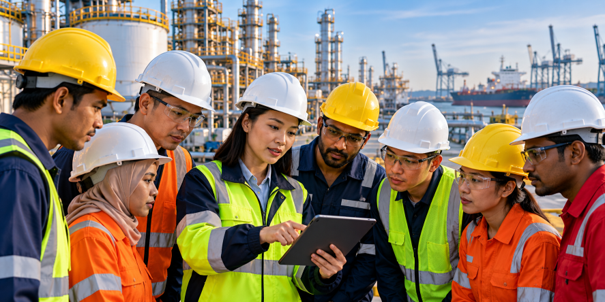
Multilingual IMDG training for maritime logistics
Maritime logistics is particularly international. A container may be packed in one Asian country, transferred through another port and ultimately transported to a completely different region.
The International Maritime Dangerous Goods Code requires shore-based personnel involved in dangerous goods transport to receive training appropriate to their responsibilities.
Providing that knowledge in a familiar language can make training substantially more accessible.
Yoursafetystore.asia offers IMDG Code Awareness Training in several Asian languages, including Chinese, Thai, Hindi, Bahasa Indonesia and Tagalog/Filipino, alongside English-language courses.
These courses introduce personnel to the international framework, dangerous goods classes, packing groups and basic safety principles. For employees who require general IMDG awareness, being able to study this material in a familiar language can reduce the risk that important concepts are lost because of language difficulties.
It also allows international organisations to provide the same core subject matter to employees in several countries while adapting the language of delivery.
Translation must preserve technical meaning
Multilingual safety training brings its own responsibility: the translation needs to be technically correct.
Safety terminology cannot always be translated literally.
A phrase that sounds natural in ordinary conversation may have a very specific regulatory meaning. Dangerous goods classifications, signal words, transport terms and technical concepts need consistent terminology.
This is particularly important when courses address international regulations such as the IMDG Code or IATA Dangerous Goods Regulations.
The translated training should preserve the meaning of the source requirements rather than rewriting technical requirements into something that merely sounds easier.
Quality assurance is therefore essential when developing multilingual safety content.
Visual communication supports language but does not replace it
Symbols, photographs, diagrams and practical demonstrations can make safety information much easier to understand.
Hazard pictograms are an obvious example. GHS pictograms provide visual hazard communication that can be recognised across language boundaries. Dangerous goods labels similarly communicate important transport hazards visually.
But symbols have limitations.
A flame symbol tells an employee that a flammable hazard is present. It does not explain the complete procedure for responding to a leaking drum. A corrosive label identifies the hazard but does not explain which gloves are suitable or how a spill should be managed.
The strongest training therefore combines understandable language with visual communication and practical examples.
Multilingual training should remain function-specific
Offering a course in an employee’s own language does not solve another fundamental training issue: the content still needs to match the person’s responsibilities.
A warehouse worker requires different knowledge from a dangerous goods consignor. A production operator in a chemical plant needs different training from an administrative employee. A person packing dangerous goods into a freight container requires more detailed knowledge than someone who only occasionally enters the logistics area.
Language and function therefore need to be considered together.
The question should be: what does this employee need to know to perform this particular job safely, and in what language can that knowledge be understood most effectively?
That approach is considerably stronger than providing the same generic English safety presentation to everybody.
Training in a familiar language does not replace local requirements
Another important distinction concerns legislation.
Asia does not have one common occupational safety law. Countries have their own legal systems, competent authorities and training requirements.
Providing an international safety course in Thai, Chinese, Hindi or Bahasa Indonesia does not automatically mean every national statutory training requirement has been satisfied.
Employers need to establish which legal requirements apply to the location and activity concerned.
Multilingual online training can provide excellent awareness and theoretical knowledge, while additional practical instruction, local regulatory content or competency assessment may still be required.
This distinction should be communicated clearly to employers and participants.
Emergency communication must also be understandable
Language becomes particularly important during an emergency.
There is little time to translate instructions when a chemical release, fire or other incident is developing.
Employees need to understand alarm signals, evacuation routes, assembly points and basic emergency procedures before an incident occurs.
Workplaces with multilingual teams should therefore examine emergency communication as part of their overall training strategy.
Can every employee understand the alarm instructions? Are emergency signs sufficiently clear? Do employees know who to contact? Can supervisors communicate critical instructions to the people they manage?
Short scenario exercises can reveal communication problems that remain invisible during classroom training.
E-learning can support multilingual organisations
Online learning offers an important advantage for companies operating across Asia: the organisation can provide consistent training content to employees in different locations while allowing participants to learn in a language that suits them.
This can be particularly useful for multinational logistics companies, shipping organisations, warehouse operators and industrial businesses.
Instead of bringing employees from several countries together for one English-language classroom session, organisations can assign appropriate online courses locally.
Employees can also repeat modules when necessary, which can be especially useful when learning technical subjects.
Yoursafetystore.asia is developing this approach through a growing portfolio of online safety courses for the Asian market. The webshop already includes IMDG Awareness courses in English, Chinese, Thai, Hindi, Bahasa Indonesia and Tagalog/Filipino, providing organisations with practical options for multilingual maritime dangerous goods awareness.
For companies employing international teams, these courses can become part of a broader multilingual training matrix.
Creating a multilingual training matrix
Large organisations can take this concept further by mapping training requirements against both job function and language.
A logistics company might have warehouse personnel in Thailand, port employees in Indonesia, administrative staff in Singapore and dangerous goods personnel in the Philippines.
Instead of asking only which course each person needs, the organisation can identify the required subject, level of competence, preferred training language and any additional local practical instruction.
This creates a much clearer picture of the organisation’s actual training needs.
It can also improve record keeping because management can see whether employees have received not just a course, but an appropriate course in a form they can reasonably understand.
Safety culture depends on communication
A strong safety culture requires employees to communicate in both directions.
Management provides information and instructions, but employees must also feel able to ask questions, report hazards and indicate when they do not understand something.
Language barriers can interfere with that process.
An employee who is unsure about an instruction may remain silent rather than admit they did not understand it. In a high-risk environment, that silence can have serious consequences.
Supervisors should therefore actively verify understanding rather than simply asking, “Do you understand?”
Practical questions, demonstrations and scenario-based discussions provide much better evidence that the information has been understood.
From translated courses to genuinely understood safety
Multilingual safety training should ultimately be judged by its effectiveness, not by the number of languages displayed on a website.
The goal is safer behaviour.
An Indonesian warehouse employee who understands why incompatible chemicals must be separated, a Thai port employee who recognises dangerous goods hazards, or a Filipino logistics worker who knows how to respond to a damaged package represents the real value of multilingual training.
Asia’s workplaces will continue to become more international. Supply chains cross national borders, companies recruit internationally and employees increasingly work within multicultural teams.
Safety systems need to reflect that reality.
Multilingual Safety Training in Asia helps close the gap between providing safety information and ensuring that information is actually understood. Combined with function-specific content, practical instruction, supervision and local regulatory requirements, it can become a powerful component of an organisation’s safety culture.
Because when safety information matters, simply saying it is not enough. The employee needs to understand it.
