
Asia is one of the world’s most important industrial regions. From electronics and semiconductor manufacturing in East Asia to petrochemical complexes in Singapore, Malaysia and the Middle East, automotive production in Thailand and India, chemical manufacturing in China and major logistics hubs throughout the region, millions of employees work every day in environments where industrial hazards must be effectively controlled.
Rapid industrial development brings enormous economic opportunities, but it also creates occupational safety challenges. Employees may work with machinery, chemicals, pressure systems, electrical installations, dangerous goods or equipment in potentially explosive atmospheres. Others perform activities such as working at height, entering confined spaces, loading tank vehicles or maintaining complex industrial installations.
Industrial Safety Training in Asia is therefore not simply about meeting a training requirement. Effective training gives employees the knowledge to recognise hazards, understand controls and respond appropriately when conditions become unsafe.
Occupational safety remains an important challenge in Asia
Industrial workplaces have changed dramatically over recent decades. Automation, robotics and digital systems have eliminated some traditional hazards but introduced new interactions between people, machinery and increasingly complex production processes.
At the same time, traditional occupational risks have certainly not disappeared.
The International Labour Organization has highlighted the substantial burden of occupational accidents and work-related diseases across Asia and the Pacific. Its regional approach emphasises prevention, stronger occupational safety and health systems, awareness, capacity building and improved workplace practices.
This is an important starting point for industrial employers. Safety should not depend solely on reacting after an accident. A mature safety system attempts to identify hazards before something goes wrong.
Training is one of the mechanisms that makes this preventive approach possible.
Asia does not have one industrial safety regulation
Companies operating internationally sometimes make the mistake of treating Asia as one regulatory region. It is not.
Singapore, Malaysia, Thailand, Indonesia, Vietnam, the Philippines, India, China, Japan, South Korea, Hong Kong and other jurisdictions have their own occupational safety and health legislation, enforcement structures and training requirements.
A multinational company may therefore establish a corporate safety standard applicable to all its Asian facilities, but that standard still needs to be combined with the legislation applicable in each country.
International frameworks can provide additional structure. ISO 45001, for example, provides an internationally recognised framework for occupational health and safety management systems. The ILO has also developed occupational safety and health management-system guidance based on the principle of systematic prevention and continuous improvement.
Training should fit within this wider system.
A course certificate cannot compensate for unsafe machinery, inadequate ventilation, missing guarding or a poorly designed process. Conversely, technically excellent equipment cannot prevent every incident when employees do not understand how it should be operated safely.
Hazard identification comes before safe behaviour
One of the most valuable skills employees can develop is the ability to recognise hazards before beginning work.
Consider a maintenance technician entering a production area. The hazards might include moving machinery, stored pressure, electrical energy, hot surfaces, chemicals and vehicle movements. The same employee may later have to work at height or enter a confined space.
Each activity requires a different risk assessment.
Industrial safety training should therefore help employees develop a questioning mindset. What can harm me? What controls are already in place? Could stored energy remain inside the equipment? Do I need a permit? Is the atmosphere safe? What personal protective equipment is required? What should I do if conditions change?
This approach is considerably stronger than simply teaching employees to follow a checklist without understanding why the controls exist.
Working at height
Falls remain one of the most obvious industrial hazards. Work at height can occur on roofs, platforms, scaffolding, ladders, storage installations and industrial structures.
The first principle should be to determine whether the work at height can be avoided. Where it cannot, suitable collective and individual protection measures need to be selected according to the applicable risk assessment and local requirements.
Employees should understand the difference between fall prevention and fall arrest. A guardrail designed to prevent someone from falling serves a different purpose from a personal fall-arrest system intended to stop a fall after it has begun.
Training should also address inspection of equipment, suitable anchor points and the limitations of personal protective equipment.
Most importantly, organisations must consider rescue. Providing a harness without determining how a suspended worker will be rescued does not create a complete working-at-height system.
Confined spaces require specialised controls
Confined spaces introduce another group of hazards that can be underestimated because the danger is often invisible.
Tanks, vessels, silos, pits, sewers and other enclosed or partially enclosed locations may contain hazardous atmospheres. Oxygen deficiency, toxic gases, flammable atmospheres and process residues can create life-threatening conditions.
Entry therefore requires careful preparation.
Depending on the installation and applicable requirements, this can include isolation, atmospheric testing, ventilation, a permit-to-work system, communication, supervision and emergency rescue arrangements.
A particularly dangerous mistake is an unplanned rescue attempt. When an employee collapses inside a confined space, colleagues may instinctively enter to help. Without proper controls, the rescuer can quickly become another casualty.
Training must therefore explain not only what employees should do but also what they must not do.
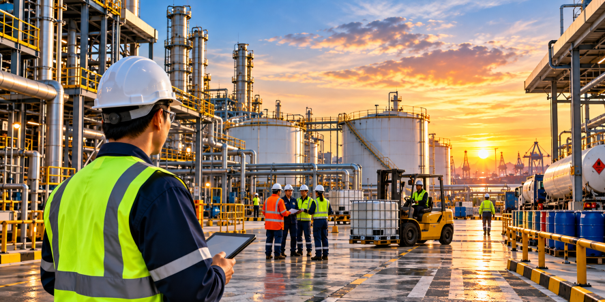
Chemicals and dangerous goods
Asian industry is closely connected with the global chemical supply chain. Factories receive raw materials, warehouses store packaged chemicals and logistics operations move dangerous goods between production facilities, ports and airports.
Employees working with these substances need to understand their hazards.
Safety Data Sheets provide important information concerning properties, hazards, protective measures, storage and emergency response. GHS labels and pictograms help communicate chemical hazards in the workplace, while transport regulations use their own dangerous goods labels, marks and classifications.
Employees should understand that these systems are related but not identical.
For organisations where personnel occasionally or regularly encounter dangerous goods, the E-learning Course Awareness Dangerous Goods (English) available from Yoursafetystore.asia can provide a useful introduction to dangerous goods legislation, classification, hazard communication and safe working principles.
This type of awareness training can form one layer of an organisation’s broader industrial safety programme.
Loading and unloading chemicals
Chemical transfer operations deserve special attention because several hazards can occur simultaneously.
During the loading or unloading of a chemical tank truck, for example, employees may encounter flammable, corrosive or toxic substances, hoses under pressure, vehicle movements and the possibility of overfilling or connecting the wrong product.
A simple connection error can potentially result in incompatible chemicals being mixed.
Before transfer begins, personnel should therefore understand the product, equipment, connections and emergency arrangements. Suitable procedures may include verification of the receiving tank, checking available capacity, securing the vehicle, inspecting hoses and connections and ensuring that required protective equipment is available.
Yoursafetystore.asia also provides an E-learning Loading and Unloading of Chemical Tank Trucks (English) course aimed at operators, drivers and other personnel involved with chemical transfer operations. It is particularly suitable as awareness or refresher training alongside the practical training and site-specific instruction required for the employee’s actual responsibilities.
Explosion safety and hazardous areas
Many Asian industrial facilities contain areas where flammable gases, vapours or combustible dusts can create explosive atmospheres.
Employees entering these areas should understand why ignition sources are controlled and why ordinary equipment cannot automatically be used in a hazardous area.
IECEx and the IEC 60079 series are important international references for explosion protection. Hazardous locations can be classified into zones according to the likelihood of an explosive atmosphere being present, while suitable equipment and working methods are selected accordingly.
Basic awareness is valuable for operators, contractors and maintenance personnel, while specialist activities such as hazardous-area classification, Ex installation, inspection and repair require a much higher level of technical competence.
Industrial training programmes should recognise this distinction rather than assuming one general explosion-safety course qualifies employees for every task.
Lockout and control of hazardous energy
Maintenance activities can expose employees to energy that remains stored inside machinery even after the normal controls have been switched off.
Electrical energy is only one example. Hydraulic pressure, pneumatic pressure, gravity, heat, mechanical movement and stored spring energy can all cause serious injury.
Lockout/tagout principles are designed to prevent machinery or equipment from being unexpectedly energised or released while people are working on it.
Effective training should explain isolation, verification and the responsibilities of people involved in the procedure. Employees must understand that simply pressing an emergency stop button or turning a machine control to the off position is not necessarily equivalent to isolating hazardous energy.
This becomes particularly important in highly automated production environments where machinery may start in response to signals from other parts of the process.
Emergency preparedness should be practised
Even strong preventive systems cannot guarantee that an incident will never occur.
Industrial organisations therefore need emergency arrangements for credible scenarios such as fires, chemical releases, spills, medical emergencies and equipment failures.
Employees should know how alarms are raised, where they should evacuate, who coordinates the response and which actions they are authorised to perform.
Practical exercises are especially valuable. Short scenario-based exercises can test whether employees understand procedures without requiring a large full-scale emergency drill every time.
A leaking drum, a small solvent spill, a worker collapsing near a confined space or smoke from a lithium battery can each be used as realistic training scenarios.
The objective is not to turn every employee into an emergency responder. It is to ensure that people recognise the situation and take the correct initial actions.
Training should match the employee’s function
One of the strongest principles for modern industrial safety training is that training should correspond with actual responsibilities.
A warehouse employee does not need the same technical knowledge as an electrical engineer. A supervisor responsible for chemical unloading needs different competencies from an office employee occasionally entering a production area. A contractor carrying out maintenance requires information about both the technical task and the site-specific hazards.
Employers should therefore develop training matrices based on functions and hazards rather than simply assigning identical courses to everyone.
Awareness courses can establish fundamental knowledge, while employees performing higher-risk or legally regulated activities may require practical instruction, competency assessment, formal qualifications or specialised certification.
Online learning works particularly well when these distinctions are respected.
Online Industrial Safety Training across Asia
Companies operating across several Asian countries face a practical training challenge. Employees can be spread across factories, warehouses, ports, laboratories and offices thousands of kilometres apart.
Online learning makes it possible to establish a consistent baseline of safety knowledge throughout the organisation.
Yoursafetystore.asia provides courses across several relevant areas, including industrial safety, dangerous goods, confined spaces, IECEx awareness, Legionella, maritime dangerous goods and chemical operations.
For organisations building a wider safety programme, the E-learning Course Awareness Dangerous Goods (English) is one practical starting point for employees who encounter hazardous materials in their work.
Online training should nevertheless be combined with local procedures, workplace instruction and practical competency assessment wherever these are necessary. Employers must also determine which specific statutory training requirements apply in each jurisdiction.
From training certificates to safety culture
The real value of industrial safety training is not the certificate issued at the end of the course.
It is what the employee does differently afterwards.
A trained employee may notice an incorrectly connected hose before transfer starts, identify an unsuitable piece of equipment before entering a hazardous area, stop a colleague from entering a confined space without authorisation or report damaged machinery before somebody is injured.
These actions are what transform knowledge into prevention.
Asia’s industrial development will continue to create increasingly sophisticated workplaces involving automation, chemicals, batteries, hydrogen, advanced manufacturing and international supply chains. Safety competence needs to develop alongside that technological progress.
Effective Industrial Safety Training in Asia provides an important foundation. Combined with engineering controls, risk assessment, suitable procedures, supervision and management commitment, it helps organisations move from reacting to accidents towards preventing them.
That is ultimately what good industrial safety is about: recognising hazards early enough that the accident never happens.
