
China and the wider Chinese-speaking business community play an enormous role in international maritime trade. Every day, containers carrying chemicals, batteries, paints, gases, industrial products and other dangerous goods move between Asian manufacturing centres and ports throughout the world. Behind every shipment is a chain of people responsible for preparing, documenting, accepting, handling, packing and transporting the cargo.
When dangerous goods are transported by sea, those people need appropriate knowledge of the International Maritime Dangerous Goods Code, better known as the IMDG Code.
For Chinese-speaking personnel, receiving this information in a familiar language can make complicated regulatory concepts considerably easier to understand. IMDG Training in Chinese can therefore support both compliance and safer working practices, particularly for employees who need general awareness of dangerous goods requirements in maritime transport.
What is the IMDG Code?
The IMDG Code is the international regulatory framework for the transport of dangerous goods in packaged form by sea. It is developed and maintained by the International Maritime Organization (IMO) and supports the safe transport of substances and articles capable of presenting risks to people, ships, cargo or the marine environment.
The Code addresses subjects including classification, packaging, marking, labelling, placarding, documentation, segregation, stowage and emergency information.
This creates a common international system.
A shipment originating in China may be packed at a factory, transported to a container terminal, loaded onto a vessel in Shanghai or Ningbo and subsequently discharged thousands of kilometres away. The companies and people handling that shipment need to communicate the hazards consistently throughout the transport chain.
That is one of the fundamental purposes of the IMDG Code.
IMDG Amendment 42-24 is mandatory in 2026
The IMDG Code is updated regularly to reflect regulatory developments, new technologies and experience from dangerous goods transport.
The 2024 Edition incorporating Amendment 42-24 became mandatory on 1 January 2026. Organisations transporting dangerous goods by sea therefore need to ensure that their procedures, documentation and training remain aligned with the applicable edition.
This also demonstrates why dangerous goods training should not be regarded as a one-time exercise.
Regulations develop. New substances and technologies enter supply chains, packaging provisions change and operational experience leads to amendments. Employees who received training several years ago cannot simply assume that every detail remains unchanged.
Refresher training is consequently an important part of an effective IMDG training programme.
Who needs IMDG training?
The training requirements extend far beyond the crew of a vessel.
Chapter 1.3 of the IMDG Code addresses shore-based personnel engaged in the transport of dangerous goods intended to be transported by sea. Training must correspond with the responsibilities of the individual employee.
This can include people who classify dangerous goods, identify proper shipping names, pack dangerous goods, apply marks or labels, prepare transport documentation, offer dangerous goods for transport, accept shipments, handle dangerous goods or load and unload cargo transport units.
Personnel involved with loading ships, preparing stowage plans, inspecting compliance and other dangerous goods functions can also fall within the training framework.
An important principle applies: employees should receive the required training before independently performing their dangerous goods responsibilities.
Where that training has not yet been provided, work requiring the training should only be carried out under direct supervision of a trained person.
General awareness and function-specific training are different
One of the most important distinctions in IMDG training is the difference between general awareness and detailed function-specific knowledge.
General awareness training introduces employees to the structure and purpose of dangerous goods regulations. It helps them understand the hazard classes, basic terminology, packing groups, hazard communication and fundamental safety principles.
That can be appropriate for administrative personnel, account managers and other employees who need to understand the IMDG system without personally performing specialised dangerous goods functions.
A packer needs considerably more detailed knowledge relating to packaging and cargo transport units. A consignor preparing dangerous goods for transport needs knowledge relevant to classification, documentation, marking and the other responsibilities of the consignor.
The training should therefore follow the function rather than simply the job title.
This distinction is particularly important when selecting an online course. An IMDG Awareness Course should not automatically be used as a substitute for the more detailed function-specific training required for personnel whose responsibilities go beyond general awareness.
Why provide IMDG training in Chinese?
International dangerous goods regulations contain specialist terminology that can be challenging even for experienced logistics professionals.
Terms such as proper shipping name, subsidiary hazard, packing group, segregation, marine pollutant and cargo transport unit have specific meanings within the dangerous goods framework.
A person may have sufficient English ability for everyday business communication while still finding detailed regulatory training difficult.
Providing awareness training in Chinese can reduce that additional language barrier.
The objective is not to create different safety standards for different languages. Exactly the opposite is true: the objective is to communicate the same fundamental safety concepts in a form that participants can understand more effectively.
This can be especially useful for Chinese-speaking personnel working in shipping companies, freight forwarding, ports, manufacturing, export operations and international logistics.
Understanding the nine dangerous goods classes
An important foundation of IMDG awareness is understanding how dangerous goods are classified.
The international dangerous goods system contains nine main hazard classes. These cover explosives, gases, flammable liquids, flammable solids and related substances, oxidising substances and organic peroxides, toxic and infectious substances, radioactive material, corrosive substances and miscellaneous dangerous substances and articles.
Class 9 has become particularly visible in modern supply chains because it includes many lithium battery shipments.
Employees do not all need to become classification specialists, but they should understand that the class communicates the primary type of hazard associated with the substance or article.
This knowledge helps personnel understand labels and placards encountered on packages and cargo transport units.
Packing groups communicate degree of danger
Certain dangerous goods are also assigned to packing groups.
Packing Group I represents a high degree of danger, Packing Group II a medium degree of danger and Packing Group III a lower degree of danger within the applicable classification framework.
Packing groups can influence packaging and other transport requirements.
Awareness training helps participants understand why this information matters rather than simply treating the letters I, II and III as administrative codes.
Correct dangerous goods transport depends on information being carried consistently from classification through packaging and documentation to final handling.
Marking and labelling communicate hazards
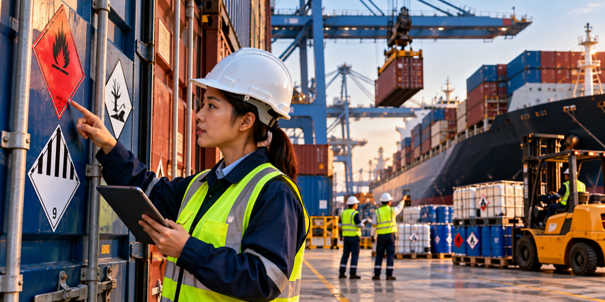
Packages containing dangerous goods may require specific marks and hazard labels.
These visual elements are essential because employees handling a package may never have seen the original Safety Data Sheet or spoken with the manufacturer. The package itself therefore needs to communicate important transport information.
Cargo transport units can similarly require placards and other markings.
Employees should be able to recognise the basic hazard communication system and understand why labels and marks must remain visible, correct and undamaged.
A damaged label may seem like a minor problem, but losing hazard information can affect decisions later in the transport chain.
Segregation prevents dangerous combinations
Dangerous goods that are individually packaged correctly can still create a serious hazard when incompatible substances are transported together.
The IMDG Code therefore contains segregation requirements.
The underlying principle is simple: if two substances could react dangerously following leakage or package damage, they may need to be separated.
Such reactions can potentially produce heat, fire, toxic gases or other dangerous conditions.
Employees involved in maritime dangerous goods operations should therefore understand that segregation is an active safety measure rather than merely a cargo-planning requirement.
General awareness training provides the foundation, while employees directly responsible for segregation or stowage require knowledge appropriate to those functions.
Lithium batteries make IMDG knowledge increasingly important
Chinese and Asian supply chains play a central role in global electronics and battery manufacturing.
Lithium-ion batteries are transported in phones, laptops, tools, vehicles, industrial equipment and energy-storage systems. They may also be shipped separately or packed with equipment.
Lithium batteries can present significant hazards when damaged, defective, improperly packaged or involved in thermal runaway.
This makes correct identification, packaging, marking, documentation and handling especially important.
Personnel should understand that not every lithium battery shipment is treated identically. Battery chemistry, configuration and other characteristics can influence the applicable requirements.
Awareness provides the starting point; personnel responsible for actually preparing such shipments need the detailed knowledge required for their function.
IMDG Awareness Course in Chinese
Yoursafetystore.asia offers an E-learning IMDG Code Awareness Course (Chinese) for personnel who need general knowledge of the IMDG Code and dangerous goods transport requirements.
The online course consists of two modules. The first introduces the IMO, international conventions and the legal and international framework. The second addresses general provisions, dangerous goods classes, packing groups and safety.
No preparatory training is required.
The course takes approximately two hours, depending on the participant’s learning pace, and concludes with a multiple-choice assessment. Participants who achieve a score of at least 70% receive the E-learning IMDG Awareness Course certificate.
Because the course is available online, employees can study without travelling to a physical training location. This can be particularly useful for companies with personnel working at several offices, warehouses, factories or logistics locations.
Chinese awareness training within a wider training programme
An awareness course should be positioned correctly within the organisation’s overall competence system.
Personnel whose role requires only general familiarity with maritime dangerous goods may benefit directly from awareness training. Employees who classify, pack, document, accept or perform other specialised dangerous goods functions need training commensurate with those responsibilities.
The employer should therefore identify the actual activities each employee performs and determine the required level of training.
This creates a stronger approach than simply providing every employee with the same IMDG certificate.
Training should also be periodically refreshed so that knowledge reflects regulatory and operational developments.
Improving maritime safety through understandable training
The success of dangerous goods regulations ultimately depends on people understanding and applying them.
A perfectly written regulation cannot prevent an incident when the employee responsible for an operation does not understand what is required. Providing training in a language familiar to the learner can remove one potential barrier between regulation and correct behaviour.
For Chinese-speaking maritime and logistics personnel, IMDG Training in Chinese can provide an accessible foundation for understanding dangerous goods transport by sea.
Combined with function-specific training where necessary, suitable procedures, supervision and periodic refresher training, it can help organisations strengthen compliance and improve safety throughout the maritime supply chain.
In a transport system where a single container can travel between several countries and organisations, clear understanding is not merely convenient. It is an essential part of dangerous goods safety.
