

Dangerous Goods Warehouse Risk Database – Professional Edition
؋9.865,64
The SafetyNet Labs Dangerous Goods Warehouse Risk Database is a professional hazard-identification and risk-prioritisation support tool.
It does not replace a legally required site-specific risk assessment, quantitative risk assessment, fire-protection engineering study, major-hazard safety report, permit assessment or competent professional judgement.
All scenarios, scores and Layers of Defence must be validated against the actual substances, quantities, packaging, building design, fire-protection systems, operations, surroundings and applicable regulatory requirements of the facility.
SafetyNet Labs Dangerous Goods Warehouse Risk Database – Professional Edition
272 scenarios. One structured approach to understanding dangerous goods warehouse risk.
Description
Turn warehouse hazards into structured, actionable risk intelligence
Warehouses storing dangerous goods face a complex combination of risks. A single incident may involve packaging failure, fire, incompatible substances, loss of containment, human error, equipment failure, external hazards or the failure of critical fire-protection systems.
The SafetyNet Labs Dangerous Goods Warehouse Risk Database – Professional Edition provides a structured starting point for identifying, assessing and managing these risks.
Developed specifically for warehouses and logistics facilities handling dangerous goods, the database contains 272 pre-defined risk scenarios, ranging from common operational hazards to complex technical failures and low-frequency, high-consequence events.
Instead of starting a warehouse risk assessment with an empty spreadsheet, safety professionals can work from an extensive scenario library and determine which scenarios are relevant to their own facility.
272 warehouse risk scenarios
The database covers a broad spectrum of causes and failure mechanisms, including:
- Corrosion and material degradation
- Erosion and mechanical wear
- External loads
- Vehicle and mechanical impact
- Overpressure
- Vacuum and low-pressure conditions
- Low and high temperatures
- Vibration
- Human error
- Maintenance failures
- External and natural hazards
Scenarios address different warehouse areas and safety-critical systems, including dangerous goods storage areas, IBC storage, drums, aerosols, gas cylinders, pallet racking, loading and unloading areas, lithium batteries, reactive substances, ventilation systems, fire detection, sprinkler systems, firewater pumps, drainage systems and high-expansion foam installations.
Beyond standard warehouse hazards
The Professional Edition deliberately goes further than conventional warehouse checklists.
It includes scenarios involving failures that may only become apparent during an emergency.
Examples include:
Fire protection system impairments
What happens if a sprinkler isolation valve remains closed after maintenance?
Firewater pump failures
Could the standby diesel firewater pump fail because the fuel level is too low or the fuel has deteriorated?
High-expansion foam failures
What happens if a warehouse door remains open during foam activation, allowing the foam to escape?
Incorrect foam concentration
Could a 3% foam concentrate be installed while the proportioning system remains configured for 2%?
Fire door failures
What happens if a fire door fails to close because its battery, drive, release mechanism or control system fails?
Emergency response errors
Could an external fire service select an inappropriate extinguishing agent because accurate information about the stored dangerous goods is unavailable?
Contaminated firewater
What happens if contaminated firewater enters the public drainage system because an isolation valve is not operated or fails to close?
Cyber-related failures
Could connected fire detection, suppression or building-control systems be manipulated or disabled?
These scenarios help organisations examine not only whether safeguards exist, but also how those safeguards themselves could fail.
Initial and residual risk assessment
The database incorporates a structured Fine & Kinney risk-ranking methodology.
Each scenario can be evaluated using:
C – Consequence
E – Exposure
P – Probability
The resulting score provides an initial indication of risk priority.
Risk levels are classified from:
Low
through Attention, Measures Required and High – Urgent,
to Very High – Stop.
After controls have been evaluated, a residual C × E × P score can be recorded to determine the remaining risk.
This allows users to compare the risk situation before and after implementation of controls.
Layers of Defence
For every scenario, the database provides structured control considerations across four categories:
Engineering LOD – Preventive
Technical measures intended to prevent the initiating event.
Engineering LOD – Mitigative
Technical systems intended to limit the consequences if the event occurs.
Administrative LOD – Preventive
Procedures, inspections, training, maintenance and management systems designed to reduce the likelihood of occurrence.
Administrative LOD – Mitigative
Emergency procedures, response arrangements and organisational measures intended to control escalation.
LOD stands for Layer of Defence.
The database therefore does more than identify hazards. It helps users evaluate whether sufficient independent layers exist between an initiating event and its potential consequences.
Risk Intelligence Dashboard
The Professional Edition includes a dedicated management dashboard that converts the underlying scenario database into clear risk intelligence.
The dashboard provides immediate visibility of:
- Total number of scenarios
- Initial High and Very High risks
- Residual High and Very High risks
- Overall risk reduction
- Initial versus residual risk distribution
- Assessment progress
- Top priority scenarios
This makes the database suitable not only for detailed safety assessments but also for management reviews, audits and risk-reduction programmes.
External and natural hazards
The database contains 64 explicit external and natural-hazard scenarios.
These include events such as flooding, extreme rainfall, heatwaves, frost, storms, lightning, earthquakes, external fires, neighbouring industrial incidents, utility failures, external pipeline failures, aircraft or drone impact and loss of critical infrastructure.
These scenarios can be compared with local site conditions and hazard information to determine their applicability.
Designed for professional use
The database can support activities such as:
- Dangerous goods warehouse risk assessments
- EHS and HSE reviews
- Fire-safety assessments
- Warehouse audits
- Gap analyses
- Emergency preparedness reviews
- Management risk reviews
- Insurer and risk-engineering discussions
- Management of Change
- Safety improvement programmes
- Due diligence
- New warehouse projects and expansions
It can be used by warehouse operators, chemical logistics companies, EHS/HSE managers, dangerous goods professionals, safety consultants, auditors, engineers, insurers and other professionals involved in dangerous goods warehousing.
International Professional Edition
The database has been developed for international use.
It is deliberately not built around one national warehouse standard. The methodology and scenario structure can therefore be applied in different jurisdictions and supplemented with applicable national legislation, permits, fire codes, insurance requirements and company standards.
International guidance and professional sources are referenced where appropriate.
A database – not just a checklist
A conventional checklist typically asks whether a requirement has been met.
The SafetyNet Labs approach starts with a different question:
What can realistically go wrong?
From there, users examine the possible consequences, existing Layers of Defence, remaining weaknesses and residual risk.
This makes the database particularly useful for organisations that want to move beyond compliance checking toward a more systematic understanding of warehouse risk.
What is included?
The Professional Edition includes:
✓ 272 pre-defined warehouse risk scenarios
✓ 64 external and natural-hazard scenarios
✓ 11 direct-cause categories
✓ Initial and residual Fine & Kinney risk assessment
✓ Preventive engineering controls
✓ Mitigative engineering controls
✓ Preventive administrative controls
✓ Mitigative administrative controls
✓ Key verification actions
✓ Applicability and status fields
✓ Management Risk Intelligence Dashboard
✓ Scales & Legend
✓ International Sources & Guidance
✓ Professional START HERE guide
The database is supplied as an editable Microsoft Excel workbook, allowing organisations to adapt the assessment to their own facility, operations and risk profile.

Related products
-

Chemical Reaction and Compatibility Tool – Professional Excel Database (English)
؋7.571,31 Add to basket -
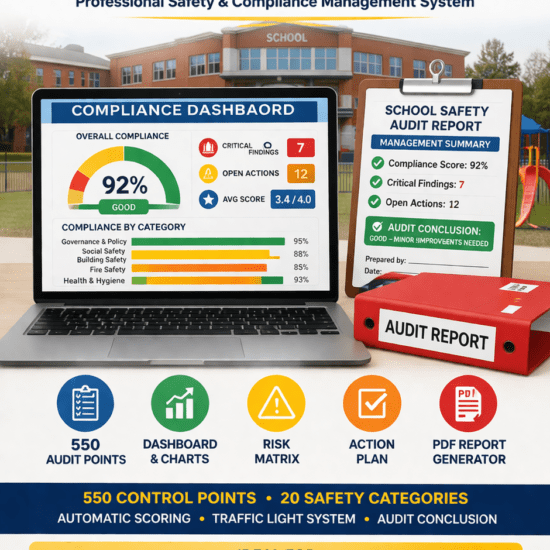
School Safety Compliance Audit Tool – Primary Education (EN)
؋22.560,97 Add to basket -
School Safety Compliance Audit Tool – Primary Education (THAI)
؋22.560,97 Add to basket -

E-Book China’s Hazardous Materials Storage – Warehouse Compliance
؋2.217,86 Add to basket