
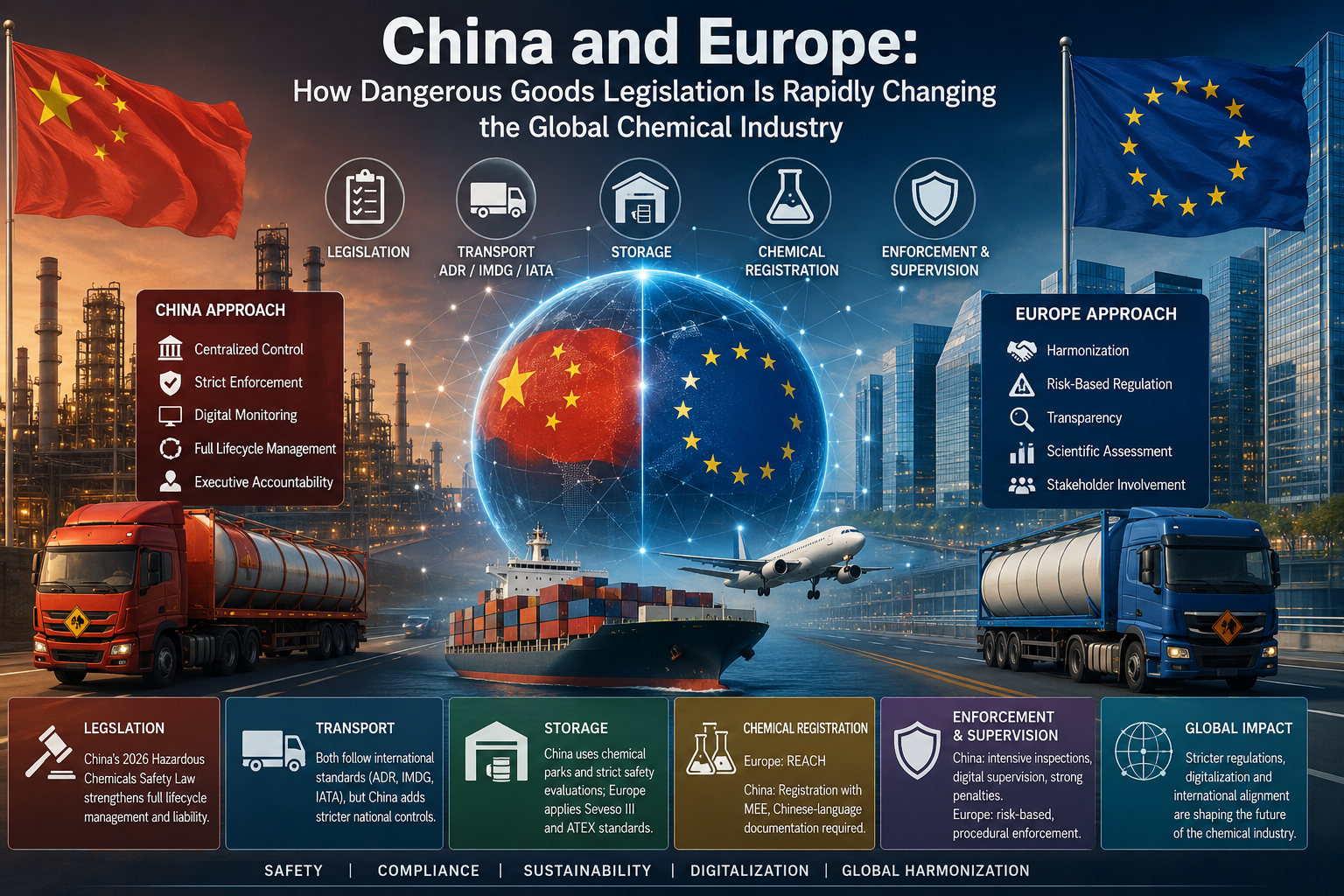
For many years, companies in Europe often viewed China as a production country where chemical manufacturing was enormous, but where regulation and enforcement were not always at the same level as in Europe. That perception has changed dramatically. Modern China is building one of the most comprehensive and tightly controlled systems for dangerous goods, hazardous chemicals, storage safety, and chemical logistics in the world.
Today, any company involved in the transport, storage, import, export, or production of hazardous substances can no longer ignore Chinese legislation. The country is transforming its entire approach to industrial safety, environmental protection, emergency management, and dangerous goods compliance. In some areas China is even becoming stricter than Europe, particularly when it comes to digital monitoring, government oversight, and personal liability for management.
At the same time, Europe remains one of the most mature regulatory environments globally. European legislation such as ADR, REACH, CLP, Seveso III, the IMDG Code, and IATA Dangerous Goods Regulations has shaped international dangerous goods management for decades. European systems are generally built around transparency, scientific risk assessment, and harmonization between countries.
China is moving in the same direction in terms of technical requirements, but the philosophy behind the system is often very different. Chinese authorities increasingly approach chemical safety as a matter of national stability and strategic control. This creates a regulatory environment that is highly centralized, increasingly digitalized, and intensively enforced.
For international companies operating between Europe and China, understanding these differences is becoming critical. Dangerous goods compliance is no longer just about labels, transport documents, or packaging. It now involves cybersecurity, digital traceability, lifecycle management, emergency planning, environmental responsibility, and real-time monitoring of hazardous chemical activities.
The Tianjin Disaster Changed China’s Entire View on Chemical Safety
One event fundamentally changed the direction of Chinese dangerous goods legislation: the Tianjin explosions in August 2015.
The explosions at the Port of Tianjin became one of the deadliest industrial disasters in modern Chinese history. Hundreds of people were killed or injured, entire areas were devastated, and investigations revealed serious failures in hazardous chemical storage, licensing, emergency planning, and supervision.
The disaster became a turning point for the Chinese government. Authorities concluded that fragmented supervision and inconsistent enforcement were no longer acceptable in a country that had become one of the world’s largest chemical producers and exporters.
Since then, China has introduced wave after wave of new legislation, technical standards, inspections, and enforcement campaigns. Dangerous goods management became a national priority.
This process reached another major milestone with the introduction of the new Chinese Hazardous Chemicals Safety Law, which entered into force in 2026. The law significantly strengthens government oversight over the full lifecycle of hazardous chemicals and introduces much stricter obligations for companies involved in dangerous goods activities.
Europe Built a Highly Harmonized Dangerous Goods System
While China has accelerated its development during the last decade, Europe has been building a coordinated dangerous goods framework for many years.
The European system is extensive and interconnected. Road transport is regulated through ADR, rail transport through RID, inland waterways through ADN, maritime transport through the IMDG Code, and air transport through ICAO Technical Instructions and IATA Dangerous Goods Regulations.
Alongside transport legislation, Europe also developed major chemical safety frameworks such as REACH, CLP, and Seveso III.
What makes the European system unique is the level of harmonization between countries. A dangerous goods shipment traveling from Spain to Germany or from Belgium to Italy largely follows the same ADR framework. Chemical manufacturers across Europe also work within the same REACH registration system.
This harmonization creates predictability for international companies. At the same time, the European system can be highly complex because different regulations overlap with one another. A company storing hazardous chemicals may simultaneously need to comply with ADR, Seveso III, ATEX requirements, fire regulations, environmental permits, occupational safety legislation, and national storage standards such as the Dutch PGS guidelines.
China Is Building a Similar System, but With a Different Philosophy
Technically speaking, China increasingly aligns itself with international systems such as:
- the UN Recommendations on the Transport of Dangerous Goods;
- GHS classification rules;
- the IMDG Code;
- ICAO dangerous goods requirements.
However, the philosophy behind Chinese legislation differs significantly from Europe.
European legislation is often based on transparency, stakeholder participation, risk analysis, and shared responsibility between government and industry. China places much stronger emphasis on centralized control and direct government supervision.
This difference becomes visible in many areas. Chinese authorities increasingly require real-time monitoring of dangerous goods transport. They impose extensive digital reporting obligations and frequently hold senior management personally liable for safety failures.
In Europe, enforcement is often more procedural. Authorities may first issue warnings, improvement notices, or administrative penalties. In China, facilities can sometimes be shut down immediately after serious violations are discovered.
Dangerous Goods Transport in China Versus ADR
Road transport is one of the areas where the differences between China and Europe become very visible.
Europe relies heavily on ADR, the international agreement governing dangerous goods transport by road. ADR contains detailed technical requirements for classification, packaging, labeling, placarding, documentation, driver training, vehicle equipment, tunnel restrictions, and loading procedures.
China uses a system strongly influenced by the same UN transport recommendations, but with additional national controls and local requirements.
One important difference is the level of state monitoring. China increasingly uses GPS systems, route monitoring, electronic permits, and digital supervision for dangerous goods vehicles. Authorities may track vehicle locations in real time and monitor whether approved routes are followed.
Another major difference is the role of local government. In Europe, ADR creates a relatively harmonized transport environment across many countries. In China, regional authorities can still impose additional local restrictions or licensing requirements.
Certain Chinese cities heavily restrict dangerous goods transport during specific hours or prohibit hazardous chemical movements in urban areas altogether.
Driver accountability is also treated differently. Chinese legislation increasingly allows for criminal liability in cases involving severe negligence or major accidents. Drivers, supervisors, and senior management can all become personally exposed to prosecution after incidents involving dangerous goods.
Maritime Transport and the IMDG Code
Sea transport plays a critical role in both European and Chinese dangerous goods logistics.
The IMDG Code, developed by the International Maritime Organization, forms the backbone of global maritime dangerous goods transport. Both Europe and China apply the IMDG Code because it is internationally mandatory for maritime transport.
The code regulates everything from classification and packaging to segregation, stowage, container packing, documentation, and emergency response.
Despite using the same international framework, enforcement practices differ significantly.
Following the Tianjin disaster, Chinese authorities dramatically increased supervision of dangerous goods ports and terminals. Chinese ports now frequently conduct extensive physical inspections, customs reviews, and documentation checks on hazardous cargo.
Temporary storage of dangerous goods in ports is also heavily controlled in China. Authorities closely monitor how long dangerous goods remain in terminals and whether segregation rules are respected.
Large Chinese ports have invested heavily in digital monitoring systems and centralized emergency response infrastructure. Chemical terminals are increasingly connected to integrated surveillance systems capable of tracking hazardous cargo movements in real time.
Europe also operates sophisticated dangerous goods port systems, especially in major ports such as Rotterdam, Antwerp-Bruges, and Hamburg. However, European ports often place greater emphasis on cooperation between regulators and industry rather than highly centralized state control.
Air Transport and IATA Dangerous Goods Regulations
Air transport of dangerous goods is one of the most strictly regulated areas globally because of the severe consequences that incidents can have during flight operations.
Both Europe and China apply ICAO Technical Instructions and the IATA Dangerous Goods Regulations. These rules govern the shipment of dangerous goods by air, including:
- classification;
- packing instructions;
- quantity limitations;
- labeling;
- dangerous goods declarations;
- training requirements.
China has become particularly strict regarding lithium battery shipments. Since China is one of the world’s largest producers and exporters of lithium batteries, Chinese authorities closely monitor compliance involving battery testing, packaging, state-of-charge requirements, and air transport declarations.
Undeclared dangerous goods shipments have become a major enforcement focus. Chinese authorities increasingly inspect e-commerce shipments and cargo consignments for hidden lithium batteries or improperly declared hazardous materials.
Training is another important area. Personnel involved in dangerous goods air transport in China are expected to demonstrate documented competency, and authorities increasingly integrate training verification into electronic supervision systems.
Europe also applies strict dangerous goods air transport rules, but China’s enforcement style is often more aggressive and inspection-driven.
Storage of Hazardous Chemicals
Storage regulation is another area where the differences between Europe and China become very interesting.
Europe generally approaches hazardous chemical storage from a risk-based perspective. Regulations such as Seveso III, ATEX, national fire codes, and PGS guidelines focus heavily on hazard identification, engineering controls, emergency planning, and environmental protection.
The Dutch PGS15 guideline, for example, provides extensive technical guidance for the storage of packaged dangerous goods. Similar systems exist elsewhere in Europe.
China also uses highly technical storage requirements, but combines these with strong administrative oversight.
A striking feature of the Chinese system is the growing importance of government-approved chemical industrial parks. China increasingly concentrates hazardous chemical activities in designated industrial zones equipped with centralized firefighting systems, emergency response centers, monitoring infrastructure, and dedicated hazardous chemical supervision.
This approach allows authorities to maintain tighter control over hazardous chemical operations. Facilities located outside approved chemical parks may face significant restrictions or even forced relocation.
The Chinese government also requires periodic safety evaluations for hazardous chemical facilities. These evaluations assess compliance with technical standards, emergency preparedness, process safety management, and environmental protection measures.
REACH and Chinese Chemical Registration Systems
One of Europe’s most influential chemical regulations is REACH, which stands for Registration, Evaluation, Authorisation and Restriction of Chemicals.
REACH fundamentally changed the global chemical industry because it placed responsibility for chemical safety directly on manufacturers and importers. Companies must provide detailed toxicological and environmental data before substances can be marketed within Europe.
China has developed a similar registration framework under the supervision of the Ministry of Ecology and Environment.
Like Europe, China increasingly applies the principle that chemical substances cannot simply enter the market without sufficient safety information. New chemical substances require registration, and Chinese authorities demand Chinese-language documentation and safety information.
However, China’s system is not simply a copy of REACH. It also serves broader national objectives such as industrial policy, market control, and strategic oversight of chemical supply chains.
Chinese authorities can also adapt legislation relatively quickly. European chemical legislation often requires lengthy political negotiations between member states and EU institutions. China can move faster when new regulatory priorities emerge.
Seveso III and Major Hazard Management
Europe’s Seveso III Directive focuses on preventing major industrial accidents involving dangerous substances.
The directive requires companies above certain threshold quantities to conduct extensive risk assessments, prepare safety reports, coordinate emergency planning, and inform surrounding communities about hazards.
China has developed similar major hazard management systems, particularly after Tianjin. Companies handling large quantities of hazardous chemicals must increasingly submit safety evaluations, emergency response plans, and digital hazard information to authorities.
However, there remains an important cultural difference. European systems generally emphasize public participation and transparency toward surrounding communities. China places stronger emphasis on administrative supervision and government control.
Enforcement and Supervision in China
Perhaps the biggest difference between China and Europe lies in enforcement.
China has dramatically strengthened dangerous goods enforcement during the last decade. The Ministry of Emergency Management now plays a central role in supervising hazardous chemical activities across the country.
Inspections have become more intensive, more frequent, and increasingly technology-driven.
Authorities may carry out unannounced inspections at hazardous chemical facilities, transport operators, logistics providers, or storage terminals. Serious violations can lead to immediate shutdowns, suspension of operations, or criminal investigations.
Chinese authorities also make extensive use of blacklisting systems. Companies with repeated violations may find it difficult to obtain permits, financing, or government approvals.
Digital monitoring is another rapidly expanding area. China increasingly integrates:
- AI monitoring systems;
- electronic permitting platforms;
- satellite tracking;
- smart logistics systems;
- centralized dangerous goods databases.
Europe also conducts enforcement campaigns, especially under REACH and Seveso, but generally follows a more gradual and procedural approach.
Cybersecurity Is Becoming Part of Dangerous Goods Compliance
An important new development in both China and Europe is the growing connection between hazardous chemical safety and cybersecurity.
Chemical facilities increasingly rely on:
- industrial automation;
- remote monitoring;
- smart logistics;
- connected OT systems;
- digital process controls.
China is rapidly integrating cybersecurity into hazardous chemical supervision. Smart chemical parks and industrial facilities increasingly operate through centralized digital platforms that combine operational safety with electronic surveillance and industrial security.
Europe is moving in the same direction through legislation such as NIS2 and the Cyber Resilience Act, although European regulation generally places more emphasis on privacy and data protection.
The Future of Hazardous Chemical Regulation
The future of dangerous goods legislation will likely involve much more than traditional transport rules or storage requirements.
Both China and Europe are moving toward systems based on:
- digital traceability;
- lifecycle monitoring;
- AI-driven inspections;
- integrated environmental compliance;
- ESG requirements;
- cybersecurity integration.
China appears determined to become a global leader in digitally controlled hazardous chemical supervision. Europe will likely continue leading in areas such as sustainability, scientific chemical assessment, environmental governance, and transparency.
For international companies, this means dangerous goods compliance is becoming increasingly multidisciplinary. Organizations now need expertise in transport law, environmental regulation, process safety, cybersecurity, emergency response, and digital compliance systems simultaneously.
Conclusion
The global regulatory landscape for dangerous goods and hazardous chemicals is changing rapidly, and nowhere is this transformation more visible than in the relationship between China and Europe.
Europe continues to operate one of the world’s most mature and harmonized systems through ADR, REACH, Seveso III, IMDG implementation, and IATA dangerous goods frameworks. Its approach emphasizes scientific risk management, transparency, and cross-border harmonization.
China, meanwhile, has transformed itself into an increasingly strict and highly supervised hazardous chemical jurisdiction. Following major industrial accidents such as Tianjin, Chinese authorities have introduced extensive reforms focused on lifecycle management, centralized supervision, digital monitoring, and executive accountability.
Although both regions increasingly align with international frameworks such as the UN Model Regulations, GHS, IMDG Code, and ICAO/IATA standards, significant differences remain in enforcement style, administrative control, and regulatory philosophy.
The era in which dangerous goods compliance could be treated as a relatively isolated operational issue is clearly over. Modern hazardous chemical regulation now touches nearly every aspect of industrial activity, from transport and storage to cybersecurity, sustainability, digitalization, and corporate governance.
For companies operating internationally, understanding both European and Chinese dangerous goods legislation is no longer optional. It is becoming a strategic necessity for maintaining safe, compliant, and resilient global supply chains.
